
I’ll be honest — I almost didn’t go to Alaska.
My original plan was Iceland. My partner had other ideas. We compromised on Alaska, which felt like picking the less glamorous sibling at the time. I’d seen the stock photos: a moose, some snow, a vague mountain. Looked cold. Looked remote. Looked like a lot of effort for scenery I figured I could find somewhere closer.
I was spectacularly wrong.
Two weeks in Alaska rearranged something in my brain. It’s one of the few places I’ve ever been where the landscape feels genuinely indifferent to your presence — not hostile, not welcoming, just ancient and enormous in a way that makes you feel appropriately small. And weirdly, that’s the whole appeal.
So here’s what I actually found, where I genuinely think you should go, and what I’d do differently if I could start over.
“Alaska doesn’t perform for you. It just exists — vast, cold, alive — and you either show up for it or you don’t.”
Before We Get Into the List
One thing that surprised me: Alaska is not one place. It’s closer to a continent crammed into a state. The southeast — the “panhandle” with Juneau and Ketchikan — is rainforest, fjords, and ferries. The interior around Fairbanks is flat tundra, midnight sun, and northern lights. South-central Alaska (Anchorage, Kenai Peninsula) is the mix most first-timers experience. And then there’s the wild western and Arctic regions most tourists never reach at all.
I’m mostly writing from south-central and southeast Alaska because that’s where I spent most of my time. But I’ll flag where the other regions deserve a mention.
I planned using the National Park Service app (free, surprisingly useful), AllTrails for hikes, and a battered copy of Moon Alaska I’d found in a used bookstore. Google Maps works fine in most populated areas, but don’t rely on cell coverage once you’re out in the backcountry.
The Places That Actually Stopped Me in My Tracks
Denali National Park & Preserve
Place 02
Kenai Fjords National Park
The mistake most people make here is booking a half-day boat tour instead of a full-day one. I made the same mistake on day one and spent the evening kicking myself.
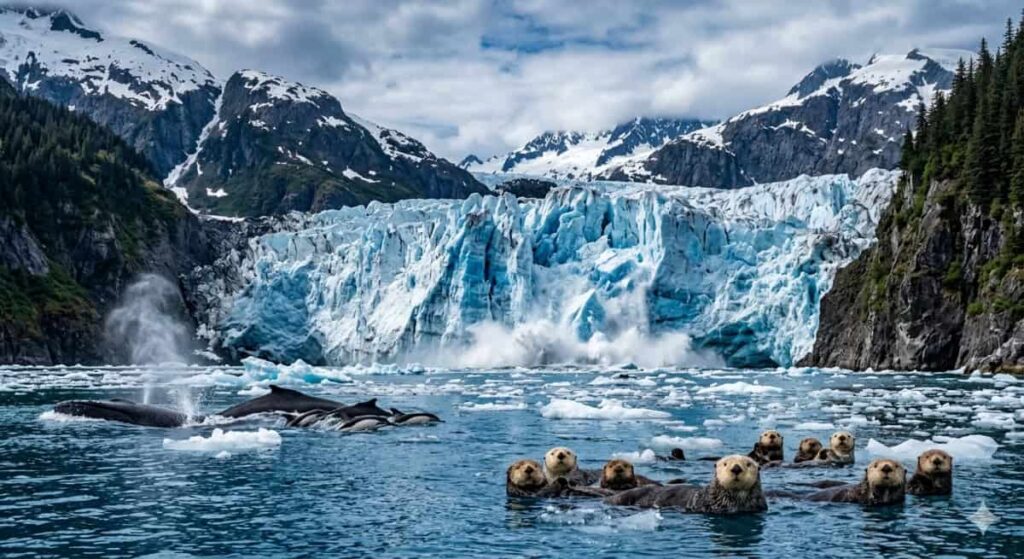
The full-day tour out of Seward gets you to the Holgate Glacier and Northwestern Fjord— places where you’re surrounded by glaciers on three sides, sea otters float past on their backs, and orcas occasionally surface close enough to make everyone grab the railing. The half-day tour is fine. The full-day tour is a different category of experience.
Kenai Fjords is also where I first understood what “tidewater glacier” actually means. Watching a wall of ice the size of an apartment building crack and thunder into the ocean — calving, they call it — sounds terrifying in theory and is actually exhilarating in person. The boat captain knew exactly where to position us. The sound hit before the wave did.
Practical note: Major Sound runs a highly rated full-day tour out of Seward. Book early for July and August. Bring seasickness medication even if you don’t think you need it — the Gulf of Alaska has opinions.
Mendenhall Glacier, Juneau
Juneau is Alaska’s capital and the only U.S. state capital you can’t reach by road — it’s fly-in or ferry only, which adds to the sense that you’ve gone somewhere properly remote. The glacier sits about 12 miles from downtown and you can walk right up to it via the East Glacier Trail.
What hit me about Mendenhall was the photo wall inside the visitor center showing the glacier’s retreat over the past century. The 1936 shoreline is marked on the ground outside — the ice used to reach almost to where you’re standing. It was a sobering reminder that “beautiful” and “fragile” aren’t mutually exclusive. See it while you can; the science on its continued retreat is not encouraging.
The hike to Nugget Falls — a 30-foot waterfall that feeds directly into the glacial lake — is short (about a mile round-trip from the visitor center) and absolutely worth doing. The combination of glacier, turquoise meltwater, and falling water is almost unreasonably photogenic.
Practical note: Cruise ship passengers flood the glacier from about 10am to 4pm. Get there before 9am or after 5pm for a much quieter experience. The visitor center on Glacier Spur Road charges a small entry fee.
Wrangell-St. Elias National Park
This one is for people who want to feel like they’ve genuinely discovered something. Wrangell-St. Elias is the largest national park in the United States — larger than Switzerland — and it sees a fraction of Denali’s visitors. The road into the Kennecott Mines area is unpaved and takes about five hours from the Glenn Highway turnoff, which naturally filters out the impatient.
The old Kennecott copper mine buildings — rust-red structures clinging to a ridge with a glacier literally next door — are one of the most visually surreal things I’ve ever seen. A working copper mine, abandoned since 1938, preserved almost by accident in the cold dry air. You can tour the mill building with a guide and the history is genuinely fascinating, but honestly just walking around the ghost town portion is enough.
The Root Glacier trail is accessible for most fitness levels and gets you onto glacier ice with crampons — a cheap rental from the small outfitter in McCarthy. Walking on a glacier sounds gimmicky. It isn’t.
Practical note: Rent a high-clearance vehicle for the McCarthy Road — there are occasional flat tires from old railroad spikes. St. Elias Alpine Guides is the main outfitter in McCarthy and runs excellent glacier walks.
The Matanuska Valley & Palmer
About an hour north of Anchorage, the Mat-Su Valley feels like Alaska with the volume turned down a little — farmland, Pioneer Peak looming over everything, and the Matanuska Glacier lurking just up the Glenn Highway. This is where Alaska grows its famously enormous vegetables (the long summer daylight does extraordinary things to cabbages and zucchini), and the valley has a quiet, lived-in beauty that the tourist-heavy spots sometimes lack.
The Matanuska Glacier itself is accessible via a private road (there’s a fee), and unlike most glaciers you can drive right up to the edge of it. No boat, no bus — you just walk up to a glacier the size of a small city. It’s also one of the few places in Alaska where you can hike on the glacier independently, without a guide, though hiring one is strongly recommended for anything beyond the edge.
Practical note: MICA Guides offers excellent glacier tours from the valley. The town of Palmer also has a good farmers market on summer weekends — worth timing your visit around if you can.
Ketchikan & Misty Fiords National Monument
Ketchikan gets dismissed as “the cruise ship town,” which is unfair. Yes, the downtown boardwalk fills with thousands of day-trippers when ships are in port. But Misty Fiords — a monument accessible only by floatplane or boat — is about as far from a tourist trap as it gets.
The floatplane flight alone is worth the trip to southeast Alaska. You take off from Ketchikan harbour, climb over rainforest, and suddenly you’re banking over granite walls rising 3,000 feet straight from the water. The fjords are narrow, dramatic, and almost always shrouded in low mist, which is where the name comes from and which makes them look like something from a fantasy novel.
We landed on a glassy lake, floated for ten minutes in complete silence, and then flew back. Two hours total. Genuinely one of the best things I’ve done in my life.
Practical note: Taquan Air and Promech Air both run floatplane tours into Misty Fiords. Book a fly-in/float-out trip if the budget allows — you spend longer in the monument and it’s worth every dollar.
Fairbanks & the Northern Lights
I’ll be upfront: I didn’t see the northern lights on my first trip. I went in August, which is technically aurora season in Fairbanks, but the nights weren’t dark enough and the solar activity wasn’t cooperating. This was my own fault for not researching properly — the prime window for aurora viewing is September through March, when Fairbanks gets genuinely dark.
But Fairbanks in summer has its own strange magic. The midnight sun is real and completely disorienting. At 2am, it’s golden-hour light. Birds are singing. Children are playing outside. You eat dinner at 9pm because it still feels like afternoon. It resets every assumption you have about what a day is supposed to feel like.
If you go in winter for the aurora: the Chena Hot Springs resort, about 60 miles outside Fairbanks, has aurora viewing tours and an outdoor hot spring that lets you soak while watching curtains of green light cross the sky. Friends who’ve done it describe it as possibly the best thing they’ve ever experienced. It’s on my list for next time.
Practical note: Download the SpaceWeatherLive or My Aurora Forecast app for real-time KP index readings. A KP of 4 or higher gives you a good shot in Fairbanks. Dress for -20°F to -40°F in midwinter — this is not optional.
When Should You Actually Go?
June–July
Peak season. Long daylight, wildflowers, wildlife. Busiest and most expensive.
Mistakes I Made (So You Don’t Have To)
Things I’d change about my trip
- Underpacking layers. I knew Alaska was cold. I still packed wrong. The rule is: whatever number of layers you think you need, add two. Weather shifts fast, especially near the coast.
- Booking the half-day Kenai Fjords tour. Already mentioned this. Don’t repeat my error. Full day, always.
- Not renting a car immediately in Anchorage. I figured the city would have decent public transit. It doesn’t, by big-city standards. A rental car is basically mandatory if you want to explore the Kenai Peninsula or Mat-Su Valley independently.
- Skipping bear spray. I borrowed some from a hostel for the hike to Nugget Falls after realizing I’d completely forgotten it. Bear encounters are rare. Not having bear spray when one happens is just bad planning.
- Underestimating distances. Everything in Alaska is farther than it looks on a map. Wrangell-St. Elias from Anchorage is technically five-ish hours — but Alaska hours, on Alaska roads. Budget more time than you think.
- Expecting cell coverage. Verizon works better than most in Alaska, but there are vast stretches with nothing. Download offline maps on Google Maps or Maps.me before you leave cell range.
One Last Thing
I’ve traveled a fair amount. I’ve been moved by the Dolomites, floored by Patagonia, and quietly awed by the Scottish Highlands. Alaska belongs in that tier — the places that don’t just check a box but actually change the way you think about the world.
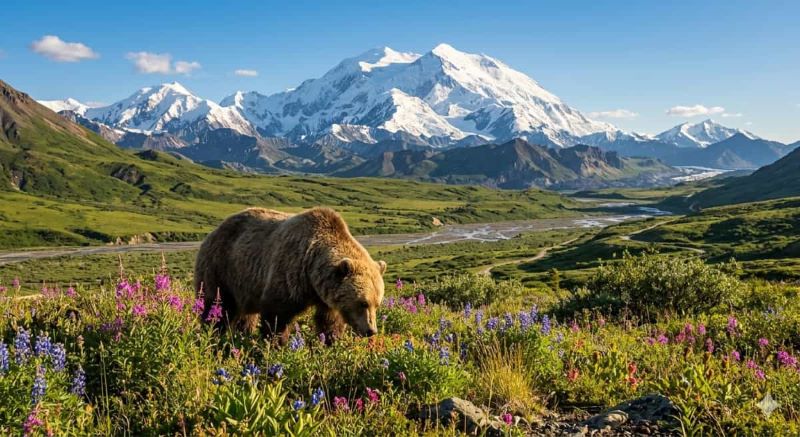
What surprised me most was how alive it felt. Not in a soft, nature-documentary way, but in a genuinely unsettling, humbling, you-are-not-the-main-character-here kind of way. A grizzly who walked within 40 feet of our bus at Denali didn’t give us a second glance. The glacier didn’t care whether we were watching when it calved. The northern lights don’t perform on schedule.
That indifference sounds like a flaw in a destination. In Alaska, somehow, it’s the entire point.
If you’re on the fence — go. Go before the glaciers retreat another mile. Go before the season closes. Go while the salmon are running and the bears are fat and the fireweed is turning the hillsides purple-pink. Go, and let it make you feel appropriately, wonderfully small.