
Most Colorful Streets in America: Places That Will Stop You in Your Tracks
The first time I turned a corner in the Haight-Ashbury neighborhood of San Francisco, I literally stopped walking. My coffee went cold. I stood there for a solid two minutes just staring at a row of Victorians painted in turquoise, gold, magenta, and sage — all lined up like they were competing for attention. My travel buddy kept walking and had to double back for me.
That was four years ago, and it’s kind of what started this whole rabbit hole.
Since then, I’ve made it a weird personal mission to seek out America’s most visually striking streets — not just “pretty” streets, but places where the color itself feels intentional, like the people who live there decided to be unapologetically bold. Some of these spots are Instagram-famous. A few are genuinely off the radar. All of them are worth going out of your way for.
Here’s what I’ve found.
1. Painted Ladies Row — San Francisco, California
Okay, yes, everyone knows about the Painted Ladies. But knowing about them and actually standing across from them at Alamo Square at golden hour are two completely different experiences.
These six Victorian houses on Steiner Street have been photographed approximately a billion times, and you’d think that would make them feel underwhelming in person. It doesn’t. There’s something about seeing the full row — lavender, pale yellow, seafoam, deep teal, coral — against the San Francisco skyline that just doesn’t get old.
What most people don’t do: walk past them and into the surrounding blocks. The whole neighborhood is a color party. Streets like Liberty, Cumberland, and 18th around Dolores Park have homes painted in colors you’d expect to see on nail polish bottles, not houses.
Practical note: Go early morning or late afternoon for photos. The midday light washes out the colors. The park across the street (Alamo Square Park) gives you the classic wide-angle view.
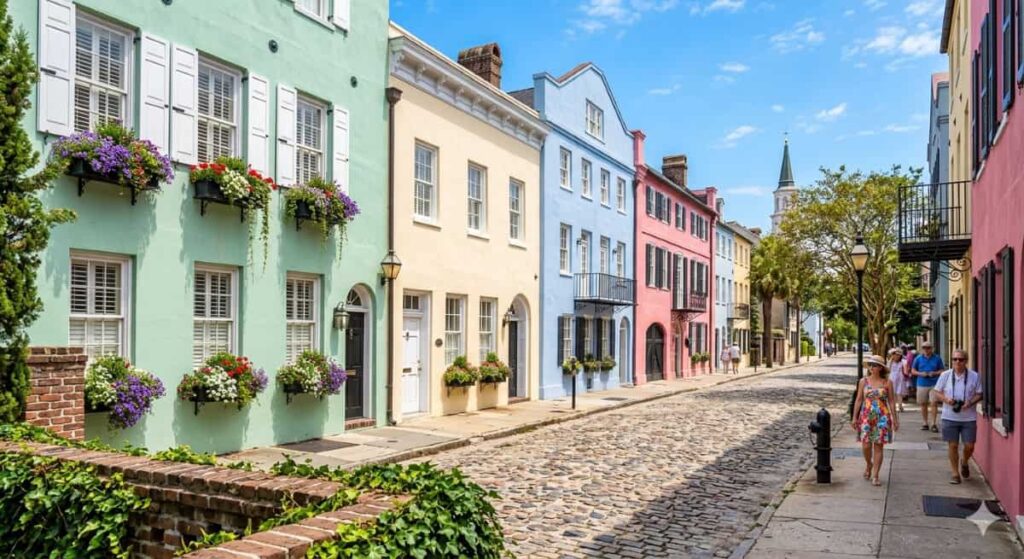
2. Rainbow Row — Charleston, South Carolina
Here’s where I’ll be honest about a mistake I made: I showed up in Charleston expecting Rainbow Row to be this sprawling, quarter-mile stretch of pastel heaven. It’s actually 13 houses on East Bay Street — not massive. But those 13 houses?
Absolutely stunning.
Salmon pink. Dusty yellow. Pale blue. Mint green. Coral. All Georgian-style architecture dating back to the 1700s and early 1800s, originally painted bright colors so merchants could identify their properties from the harbor. The history layered onto the color makes it feel even more meaningful.
What surprised me was how lived in it feels. These aren’t museum pieces — people actually reside in some of them. You’ll see potted plants on stoops, window boxes, cats in windows. That lived-in quality makes Rainbow Row feel more authentic than a lot of tourist attractions.
Walk a block or two off East Bay Street and the whole French Quarter neighborhood continues the pastel theme in a more relaxed way. Great street food and coffee shops nearby if you need a break from staring at buildings.
3. Haight-Ashbury — San Francisco, California (Again, Worth It)
I know I already mentioned SF, but Haight-Ashbury deserves its own entry because it’s a totally different vibe from the Painted Ladies.
Where the Painted Ladies feel curated and elegant, Haight-Ashbury feels like it’s still running on 1967 energy. Purple houses with rainbow murals. Green storefronts with hand-painted signs. Fences covered in mosaics. It’s organized chaos in the best way.
The stretch of Haight Street between Masonic and Stanyan is where most of the action is, but the side streets — Cole, Shrader, Clayton — are where the real gems hide. I stumbled down Clayton Street one afternoon and found a house painted entirely in deep navy with gold lotus flowers stenciled along the fence line. Nobody was photographing it. It felt like a secret.
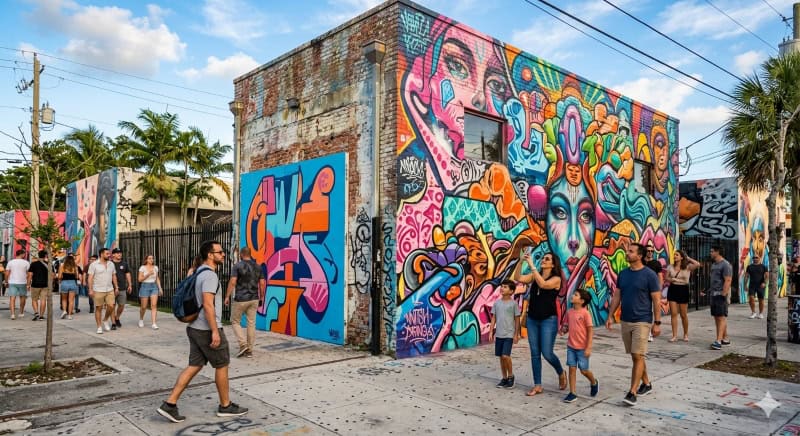
4. Art Basel’s Wynwood Walls — Miami, Florida
Okay, technically Wynwood isn’t just one street — it’s a whole neighborhood. But the street art concentration here is unlike anything else in the country.
The Wynwood Walls on NW 2nd Avenue started as an outdoor museum project back in 2009, and now the entire neighborhood has caught the energy. Every alley, warehouse wall, parking lot barrier, and building exterior has become fair game. Street artists from all over the world have painted here.
When I visited, I went in with the Google Maps “Wynwood Walls” pin and ended up wandering for three hours. The colors are aggressive in the best way — hot pinks, deep violets, acid greens, electric oranges. It’s not gentle. It’s loud.
What I’d do differently: Download the Wynwood app (yes, there’s an app) before you go. It maps the murals and tells you who painted what. Otherwise you’re just guessing. Also, most of the best walls are on NW 2nd Ave and NW 25th Street, but the blocks around there keep expanding.
5. Lombard Street Area — San Francisco (Yes, SF Three Times)
Look, I can’t help it that San Francisco decided to be the most colorful city in America.
Lombard Street is famous for being the “crookedest street in the world,” but what people overlook is that the surrounding Russian Hill neighborhood is loaded with color. Block down from Lombard on Macondray Lane — which you can only reach on foot — feels like you’ve wandered into a secret garden. Wooden cottages painted in faded periwinkle and sage, flower boxes everywhere, cats on every porch.
It’s not flashy. It’s the opposite — quiet and soft. But the color palette feels deliberate in a way that’s hard to articulate until you’re standing in it.
6. The Garden District — New Orleans, Louisiana
New Orleans, in general, is a color story, but the Garden District specifically hits different.
The homes on Prytania Street, St. Charles Avenue, and Coliseum Street are these massive antebellum mansions painted in deep greens, dusty pinks, rich creams, and burgundies that don’t exist anywhere else. The color choices feel Southern in a specific way — rich but slightly faded, like they’ve earned their patina over 150 years.
What I didn’t expect was how much the landscaping contributed to the color. Bougainvillea climbing wrought iron fences. Purple wisteria dripping from second-floor balconies. The houses and the plants are in a conversation with each other about color.
Walk Magazine Street for the neighborhood vibe, then cut over to the quieter residential blocks for the best house watching.
7. Balmy Alley — San Francisco’s Mission District
Okay, last SF entry, I promise.
Balmy Alley in the Mission District is one block long (between 24th and 25th Streets, off Treat Avenue) and it might be the most densely colorful block in the country. Both sides of the alley are covered floor to ceiling in murals — political art, community art, Day of the Dead imagery, Indigenous iconography, protest art.
It’s heavy in a beautiful way. Walking through it feels like reading a community’s history in color.
This isn’t a place to zip through for a photo. Take your time. Read the murals. Some of them have been there for decades and carry real weight.
Common Mistakes People Make When Visiting These Streets
Going at the wrong time. Midday light is brutal for color photography and for your own experience of the colors. Early morning and the hour before sunset are when these places truly glow.
Sticking only to the famous spots. Every neighborhood on this list has a “famous” point and then a deeper color experience a block or two away. The Painted Ladies are great, but the streets around them are better for actually feeling like you’re inside the neighborhood.
Forgetting it’s a neighborhood, not a museum. People live on Rainbow Row. People live on the Painted Ladies block. Be respectful — don’t peer into windows, don’t sit on stoops without asking, don’t blast music. These places are beautiful because people take care of them.
Over-filtering your photos. This is a personal thing, but the colors on these streets are already maxed out. When you crank the saturation in Lightroom or VSCO, you end up with something that looks fake. Trust the natural light and real colors.
How to Plan a Color-Chasing Road Trip
If you wanted to hit the best of these in one trip, here’s how I’d structure it:
Start in Miami (Wynwood) for two days. Fly into MIA, explore the neighborhood on foot, grab dinner on NW 2nd Avenue.
Fly to New Orleans next. Spend a day in the Garden District and another wandering the French Quarter. The colors everywhere in NOLA reward slow walking.
Drive or fly up to Charleston for a night — Rainbow Row is walkable from most downtown hotels. The whole peninsula rewards aimless wandering.
Finish in San Francisco for three days. The city is compact enough that you can hit Haight-Ashbury, the Mission, Alamo Square, and Russian Hill in a long weekend on foot or by Muni.
The Google Maps lists function is your friend here — I kept a running list called “Color Streets” and dropped pins whenever I found something unexpected. Over time it became its own little atlas of places worth returning to.
Why This Actually Matters
I know “colorful streets” sounds like a lightweight travel category — Instagram bait, basically. But there’s something that keeps pulling me back to these places that has nothing to do with photographs.
The neighborhoods that invest in color tend to be neighborhoods that invest in community. Charleston’s Rainbow Row survived because residents cared enough to maintain it across centuries. Wynwood exists because artists and property owners decided to make something together. Balmy Alley’s murals are activism and memory at the same time.
Color is rarely accidental. When a street looks the way these streets look, it’s because someone decided to make it that way. That decision, maintained over years and sometimes generations, says something about the people who live there.
That’s what I stood staring at on that street in San Francisco four years ago, coffee going cold. Not just a pretty house — a choice, repeated every time someone repainted, every time a neighbor matched the palette, every time a newcomer chose to fit in rather than disrupt.
America has a lot of those streets. They’re worth finding.