
10 Small Towns in America That Look Unreal (I’ve Seen Some of These With My Own Eyes)
I’ll be honest — I used to be a “big city or nothing” kind of traveler. Give me New York, Chicago, San Francisco. I wanted skylines, rooftop bars, and that electric energy of a place that never sleeps.
Then a road trip changed everything.
A few years back, I took a detour through the Smoky Mountains because my GPS routed me around a highway accident. I ended up crawling through this tiny town in Tennessee — fog draped over the mountains, old wooden storefronts lit up in the late afternoon sun, maybe three cars parked on the main street. I pulled over, rolled down the window, and just sat there for a minute.
It didn’t look real. It looked like a painting someone had forgotten to put in a museum.
Since then, I’ve made it a point to seek out these kinds of places. Some I’ve visited myself, some came through the recommendations of friends who travel the back roads for a living. All of them share one thing: the moment you arrive, you instinctively reach for your camera because your brain can’t fully process what it’s seeing.
Here are 10 small towns in America that genuinely look like they belong on a movie set — or at least inside a dream.
1. Marfa, Texas — The Desert Mirage That’s Completely Real
Nobody believes you when you tell them there’s an internationally recognized arts destination sitting in the middle of the West Texas desert, population around 1,800 people.
Marfa is surreal in the most literal sense. Flat, dusty nothing for miles, and then suddenly — minimalist art installations, a legendary hotel (the Hotel Paisano, where James Dean once stayed), and a sky at night so clear it feels like the stars are performing just for you.
The “Marfa Lights” phenomenon — unexplained glowing orbs seen from a dedicated viewing area outside town — adds another layer of weirdness that you just have to experience for yourself.
What most people don’t know: the town smells incredible. Something about the high desert air mixed with the occasional rain. It’s one of those sensory details that photos will never capture.
2. Eureka Springs, Arkansas — A Victorian Time Capsule Hidden in the Ozarks
If you told someone you’d stumbled onto a fully intact Victorian village tucked into the hills of Arkansas, they’d think you were exaggerating. You’re not.
Eureka Springs sits on a hillside so steep that the town was literally built into the mountain. There are no true flat streets. Every road curves, climbs, or dips dramatically. The downtown is a National Historic District where the buildings look exactly as they did in the 1880s — and somehow feel completely lived-in and vibrant today.
I had coffee at a café built into the side of a cliff. The window next to my table looked straight down into a wooded ravine. This is just a regular Tuesday morning in Eureka Springs.
The Spring Street area, especially in autumn when the leaves turn, is almost aggressively beautiful. Bring a good pair of walking shoes — those hills are no joke.
3. Leavenworth, Washington — Bavaria in the Cascades
Here’s one that genuinely stops people mid-scroll on Instagram: a full-on Bavarian village nestled in the Cascade Mountains of Washington State.
Leavenworth was a struggling logging town in the 1960s when the community made a radical decision: go full Bavarian theme or go home. They rebuilt the entire downtown in the German Alpine style. Lederhosen, Oktoberfest, nutcrackers, gingerbread architecture — the whole nine yards.
What’s surprising is how not cheesy it feels in person. The surrounding mountains are genuinely majestic. The Wenatchee River runs cold and clear through town. In winter, when it snows, the place looks like someone turned a snow globe upside down and forgot to put it back.
My mistake the first time: going in peak summer. The crowds are intense. Go in November or early December when the Christmas lights are up but the tourist rush hasn’t fully hit. That’s when the magic is real.
4. Kennebunkport, Maine — A Postcard That Walks Back
New England has no shortage of charming coastal towns, but Kennebunkport operates on a different level entirely.
The combination of Colonial-era architecture, lobster shacks hanging over the water, lighthouses on rocky outcroppings, and that signature Maine light (something about the angle of the sun up there makes everything glow amber) creates an environment that photographers chase for their whole careers.
Dock Square in the heart of town is exactly what you imagine when someone says “quaint New England village.” White church steeple. Independent bookshop. Bakeries that open at 5 AM because the fishing boats start earlier.
One thing nobody warns you about: the seagulls are committed thieves. I lost half a lobster roll to a bird that had clearly done this before. Still worth it.
5. Waimea, Hawaii — The Cowboy Town on the Big Island Nobody Talks About
Everyone knows Hawaii for beaches and volcanoes. Far fewer people know about the Hawaiian Paniolo — the cowboys — and the ranching culture that exists in the highlands of the Big Island.
Waimea (also called Kamuela) sits at around 2,500 feet elevation in the center of the Big Island, surrounded by rolling green hills, working cattle ranches, and mountains that disappear into low-hanging clouds. The air is cool and misty. Horses are grazing in fields visible from the main road.
It looks nothing like your mental image of Hawaii, and that’s exactly why it’s extraordinary.
Parker Ranch — one of the oldest and largest cattle ranches in the U.S. — anchors the whole area. The local farmers market here is one of the best I’ve ever been to. Fresh produce grown in volcanic soil, local honey, genuinely good coffee.
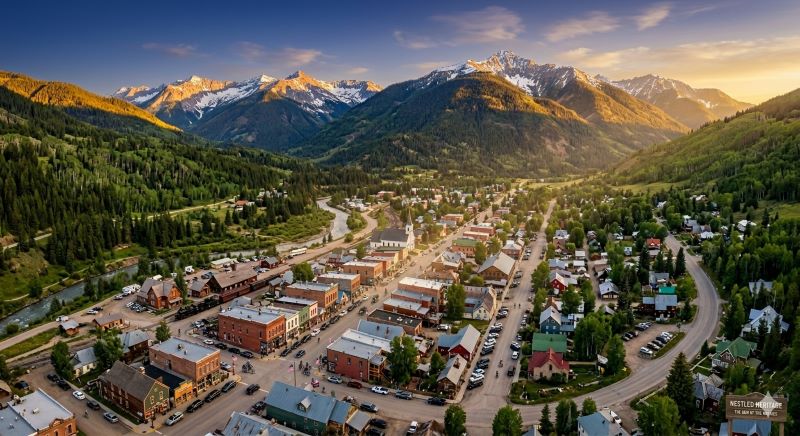
6. Telluride, Colorado — A Box Canyon So Beautiful It Should Be Illegal
Telluride is physically contained by mountains on three sides, sitting in a box canyon at around 8,750 feet. There’s essentially one road in and one road out. The town itself is only about a mile long.
And it is absolutely, completely, outrageously gorgeous.
Victorian-era buildings line Colorado Avenue, painted in bright colors against the backdrop of 13,000-foot peaks. In summer, wildflowers erupt across every hillside. In winter, the mountain takes over and the town becomes something from a fantasy novel.
The free gondola that runs between Telluride and the Mountain Village above is worth riding even if you’re not skiing. The views from up there are the kind that reset something in your brain.
Fair warning: altitude hits hard if you’re not used to it. Drink water constantly, take it slow the first day, and don’t try to do a mountain hike on your first afternoon. I learned this the uncomfortable way.
7. Natchez, Mississippi — Where Antebellum Grandeur Meets the Mississippi River
Natchez isn’t talked about nearly enough, and I think it’s because people don’t know what to make of a place with this much complicated history sitting alongside this much undeniable beauty.
The bluffs above the Mississippi River are breathtaking. The antebellum mansions — over 1,000 historic structures in a town of around 15,000 people — are architectural marvels. Grand porches, towering columns, Spanish moss hanging from ancient oaks.
The historic district at night, lit by old-style street lamps, is the kind of scene that makes you feel like you’ve stepped out of time.
Natchez is also a town that’s having real conversations about its history, which makes visiting it thoughtful rather than just picturesque. Stop into the Forks of the Road site, one of the largest slave markets in the South, which is now a memorial. The full picture of the place matters.
8. Sedona, Arizona — The Red Rock Cathedral
I used to think photos of Sedona were edited. The reds and oranges of those sandstone buttes against that pure blue sky — surely someone had cranked up the saturation in Lightroom.
They hadn’t.
Sedona’s famous red rock formations — Cathedral Rock, Bell Rock, Coffee Pot Rock — are genuinely that color. The iron oxide in the sandstone turns them into something that glows in the morning and evening light like they’re lit from inside.
The town itself is small and walkable, with a main stretch of galleries, restaurants, and shops. It’s more tourist-forward than some places on this list, but the landscape so thoroughly dominates everything that it doesn’t matter.
Go to Airport Mesa for sunset. It’s a short drive up a dirt road and you’ll be rewarded with a 360-degree view of the whole basin turning gold. Bring a jacket — desert evenings go cold fast.
9. Hot Springs, Arkansas — Art Deco Bathhouses and Thermal Springs on Bathhouse Row
Hot Springs sits in the Ouachita Mountains and has been drawing visitors since the 1800s for its naturally occurring thermal spring water. What emerged along Central Avenue — known as Bathhouse Row — is one of the most extraordinary streetscapes in America: eight grand early 20th-century bathhouses, now a National Park, sitting side by side in full architectural glory.
The Buckstaff Bathhouse still operates as an actual bathhouse. The Fordyce Bathhouse is now a museum. Walking the row feels like being transported to a different era entirely.
The surrounding town is equally interesting — a small city with a thriving art scene, excellent food (the fried catfish here is unreal), and a genuinely welcoming energy. It doesn’t feel performatively quaint. It just feels like itself.
10. Jerome, Arizona — A Ghost Town That Refused to Die
Jerome clings to the side of Cleopatra Hill at a nearly 30-degree angle. The whole town looks like it might slide down the mountain at any moment, and in fact, some of it already has — there’s a building known as the “Sliding Jail” that has moved over 200 feet from its original location due to dynamite blasts from the old copper mines below.
At its peak in the early 1900s, Jerome was a booming copper mining town of 15,000 people. By the 1950s, it was essentially abandoned — a true ghost town. Then artists and outliers started moving in during the 1970s, and the population slowly crept back up.
Today it’s a town of about 450 people, and it is one of the most visually arresting places I’ve ever stood in. Old brick buildings perched on steep slopes, panoramic views of the Verde Valley below, eclectic galleries and wine bars tucked into spaces that used to be saloons.
The Douglas Mansion — now the Jerome State Historic Park — is worth the small admission fee. The mine tunnels below it actually caused the building to shift on its foundation.
A Few Things I’ve Learned From Chasing These Places
The biggest mistake most people make is only visiting these towns during peak season. These places are designed by nature or history to be beautiful, but they’re most magical when the crowds are thinner.
Shoulder season — late spring and early fall — is almost always the sweet spot. The weather is good, the prices are lower, and you can actually hear the place breathe.
Also, put the phone down occasionally. I know that sounds rich coming from someone who just wrote 1,500 words encouraging you to go look at things. But there’s a moment at each of these places where you stop mid-frame, realize you’re trying to capture something that cameras genuinely can’t capture, and just experience it for a while.
That moment in Eureka Springs when the fog rolled over the Victorian rooftops at dawn. The silence at Marfa after midnight. The way the last light hits Cathedral Rock in Sedona.
Those things don’t fit in a phone. They barely fit in memory. But that’s exactly why they’re worth the drive.
Planning a road trip? Drop the name of your home state and I can point you toward which of these is most worth the detour from where you are.
Pingback: Hidden Beaches in Florida Nobody Knows About - cnbtub.com